‘White-tail’ Fokker 50s: white and colored
In the past the major reason why an airliner came off the production line painted all white was when there was not a firm contract signed at the moment of completion or at the first flight. In aviation language this situation is commonly referred to as ‘white-tail’ aircraft.
During the period 1991 to 1994 many aircraft manufacturers, including Fokker, experienced low sales. With production lines for Fokker 50 and Fokker 100 active at the time, the production rate remained higher than sales. Evidently this resulted in an increased number of ‘white-tails’. Fokker defined a ‘white-tail’ as an aircraft for which the period between its first flight and signing of the contract exceeded four months.
As aircraft manufacturers do not want to focus attention to slow sales the Fokker management decided for a creative solution: unsold F50s were provided with color in the form of a blue triangle with an orange rim on the tail in order to making them less noticeable. It remains unknown why this triangle-procedure was not applied to F100 aircraft that came off the production line unsold; in contrast to F50s, ‘white-tail’ F100s remained fully white.
Most of these ‘white-tail’ F50s were flown to Woensdrecht for storage, some remained at the Fokker factory in Amsterdam. Therefore, it was rare to observe an F50 with the colored tail outside these two Fokker locations.
Nowadays there is another reason why airliners leave the manufacturer's paintshop in all white: those aircraft are to be used for ACMI (aircraft, crew, maintenance and insurance) operations in which they are leased to an operator for a shorter or longer period. In such cases an all white livery is often preferred as it increases flexibility when leasing to different operators on short notice and it of course saves painting costs. By the way, ACMI did not play a role during the period under consideration in this article.
F50s with the triangle on the tail
For this article I have attempted to trace all ‘triangle’ F50s. At first I searched available databases for the time elapsed between the first flight and the date of signing the contract and then reviewed photo collections for pictures made during the ‘white-tail’ period: either all white or with the colored triangle on the tail. I am unaware of any accessible Fokker documents regarding whether unsold F50s were painted in the triangle livery.
The situation was found to be a bit complicated as some F50s were painted in the triangle scheme because no firm contract was signed when they left the factory, while a deal was closed shortly afterwards. Therefore, the triangle may have been applied for a short period only, whereas these F50s were not considered being ‘white-tails’ in the Fokker terminology. Also, not all F50s in fully white paint were ‘white-tail’ aircraft by definition. These two entities are indicated separately in the table below.
Research shows that the first true ‘white-tail’ F50 was completed in mid 1991 (PH-JXC, c/n 20226), which flew for the first time on 24 July 1991 and was stored at Woensdrecht three weeks later. Over the subsequent two years it was intermittently used for demonstration flights, provided with ‘Fokker 50’ titles and the Fokker logo. Only in 1993 Fokker succeeded in finding an operator for this airframe.
According to available data the first F50 carrying the triangle on the tail was PH-JXD (c/n 20228), which made its maiden flight on 20 August 1991 and was ferried to Woensdrecht on 9 September. It returned to Amsterdam on 13 September for a demonstration to an Indian delegation. Three days later it was flown back to Woensdrecht for storage and noted here on 17 September carrying the colored triangle on the tail. This is the first documented sighting of any F50 in the ‘triangle’ livery anyway.
Over the next years the number of ‘white-tail’ F50s rapidly increased and in early 1994 there were 18 in storage (see diagram). From that moment on F50 sales recovered and Fokker sold their last ‘white-tail’ F50 in February 1996 (c/n 20287). The table contains all F50s that were ‘white-tail’ by the Fokker definition and/or had the colored triangle on the tail. In total there have been 26 ‘white-tail’ F50s and 27 F50s with the triangle on the tail; of these, 20 were true ‘white-tails’ with a colored tail.
White-tail F50s
| c/n | Registration | First flight date | Contract date | WT | TT | Remarks |
|---|---|---|---|---|---|---|
| 20226 | PH-JXC | 19-07-1991 | 06-1993 | ● | Also used as F50 demonstrator. | |
| 20228 | PH-JXD | 20-08-1991 | 19-08-1992 | ● | ● | |
| 20230 | PH-JXF | 13-09-1991 | 21-06-1993 | ● | ||
| 20231 | PH-JXG | 23-09-1991 | 09-08-1991 | ● | ||
| 20232 | PH-JXJ | 02-10-1991 | 07-1992 | ● | ||
| 20233 | PH-JXK | 11-10-1991 | 07-1992 | ● | ● | |
| 20239 | PH-JXN | 20-01-1992 | 12-1991 | ● | ||
| 20246 | PH-KXF | 10-03-1992 | 01-1994 | ● | ● | |
| 20247 | PH-KXG | 11-03-1992 | 01-1994 | ● | ● | |
| 20252 | PH-KXM | 29-04-1992 | 14-12-1992 | ● | ||
| 20253 | PH-KXO | 18-05-1992 | 13-02-1996 | ● | ● | |
| 20254 | PH-KXN | 21-05-1992 | 11-12-1992 | ● | ● | |
| 20255 | PH-KXS | 02-06-1992 | 24-09-1992 | ● | No photo of triangle livery, but sighting on 27 May 1992 at Amsterdam reported. | |
| 20256 | PH-KXT | 12-06-1992 | 01-1994 | ● | ● | |
| 20261 | PH-KXW | 21-08-1992 | 09-1992 | ● | ||
| 20266 | PH-LXW | 10-11-1992 | 03-12-1992 | ● | Had ‘First Fokker 50 High performance’ titles. | |
| 20270 | PH-LXJ | 09-12-1992 | 01-1994 | ● | ● | |
| 20271 | PH-LXK | 08-01-1993 | 01-1994 | ● | ||
| 20276 | PH-LXP | 16-02-1993 | 01-1994 | ● | ● | |
| 20277 | PH-LXR | 24-02-1993 | 01-1994 | ● | ● | |
| 20279 | PH-LXT | 19-02-1993 | 20-12-1994 | ● | ● | |
| 20280 | PH-LXU | 01-04-1993 | 04-02-1994 | ● | ● | |
| 20282 | PH-MXE | 21-04-1993 | 04-02-1994 | ● | ● | |
| 20283 | PH-MXF | 04-05-1993 | 06-03-1995 | ● | ● | |
| 20284 | PH-MXG | 18-05-1993 | 25-11-1994 | ● | ● | |
| 20286 | PH-MXH | 28-06-1993 | 25-11-1994 | ● | ● | Had UAE and Saudi flags and 'Fokker 50 high performance' titles for trials in Abu Dhabi and Saudi Arabia in August 1993. And on 12 December 1993 seen at Amsterdam with ‘Fokker 60 Utility KLu Evaluation flight’ around the RNLAF roundel. |
| 20287 | PH-MXI | 15-07-1993 | 13-02-1996 | ● | ● | Noted with Red Cross logos for a movie recording in early September 1995. |
| 20288 | PH-MXJ | 02-08-1993 | 17-02-1994 | ● | ● | |
| 20298 | PH-MXT | ● | Registration applied in error, corrected to PH-MXR before first flight. | |||
| 20298 | PH-MXR | 20-01-1994 | 03-1995 | ● | ● | |
| 20299 | PH-MXS | 18-02-1994 | 17-03-1994 | ● | ||
| 20302 | PH-JCE | 16-03-1994 | 03-03-1995 | ● | ● | Seen with small ‘Vietnam Airlines’ titles and logo for demo flights in Paris on 12 May 1994. |
| 20303 | PH-JCF | 17-02-1995 | 12-07-1995 | ● | Had 'Royal Jordanian' titles in March 1995 for promotion trip in Middle East and 'Tarom' livery in May 1995 for demonstration in Romania. |
WT: 'White-tail' as per Fokker definition. TT: triangle on the tail by photo proof.
F50s with triangle livery and special titles
On several occasions Fokker used ‘triangle’ F50s for demonstration flights to potential customers and they were sometimes adorned with special titles or logos. Five have been documented, as can be seen in the table. Since it was not uncommon that Fokker applied stickers with the potential operator’s name for demonstration flights, there may have been more of these special titles on F50s with the triangle on the tail. If you have any data or pictures that can add to our knowledge, please let me know.
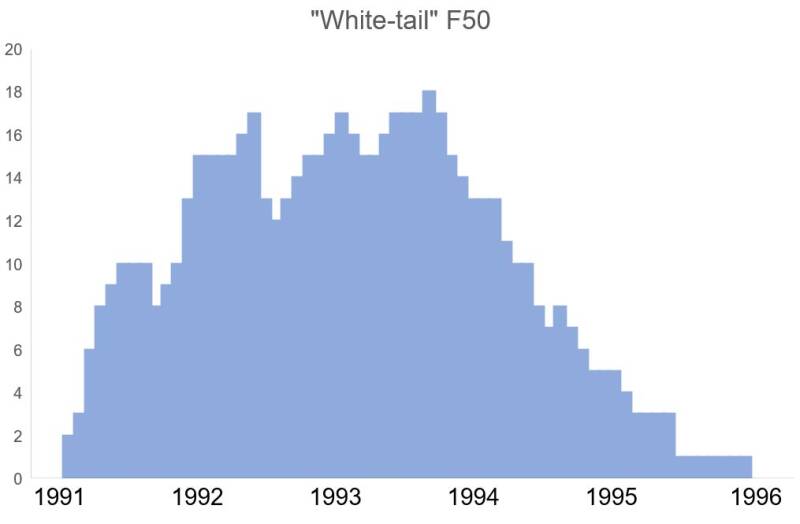
Number of ‘white-tail’ F50s per month over the years (Fokker data, courtesy of Frank Ellemers)
'White-tail' F50 pictures
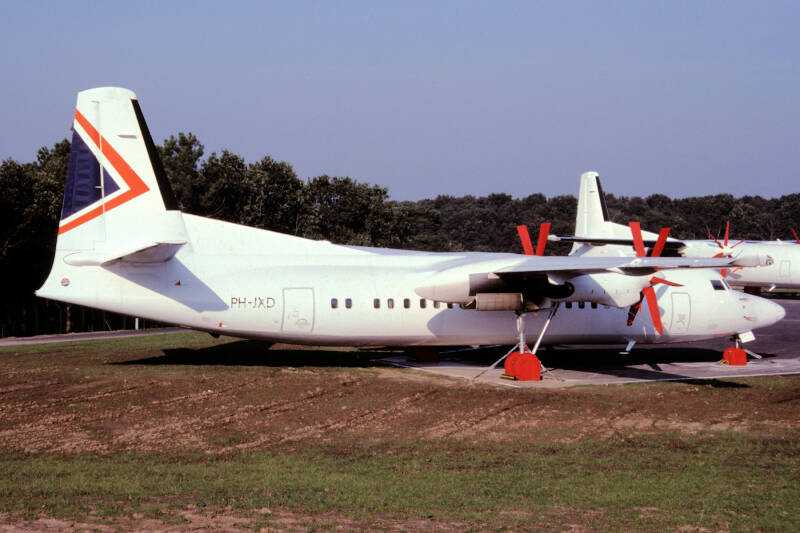
PH-JXD (20228) stored at Woensdrecht with props covered. (unknown photographer, slide scan from author’s collection; Woensdrecht, November 1993)

PH-LXW (20266) with special titles indicating the first F50 with Pratt & Whitney PW127B engines for increased performance. (unknown photographer; Amsterdam, 1993)

PH-MXH (20286) with flags of United Arab Emirates and Saudi Arabia before a promotion trip. (unknown photographer, photo scan from Hans Groen collection, Amsterdam, August 1993)
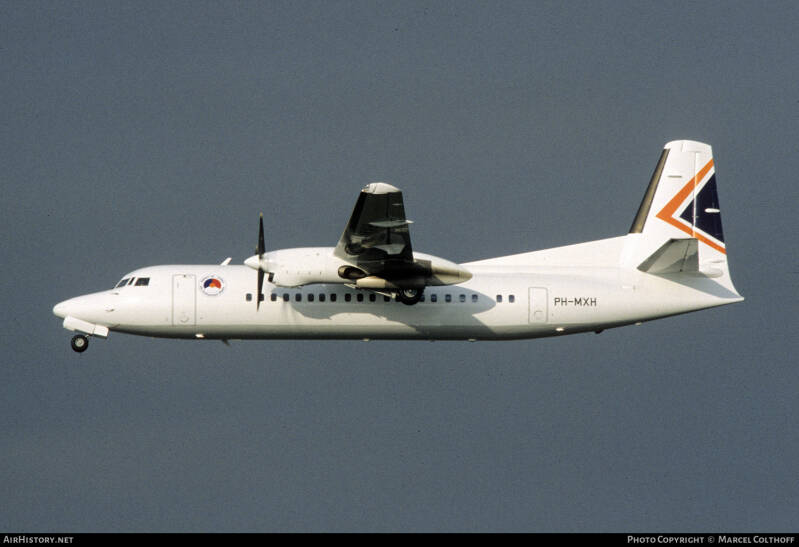
PH-MXH (20286) with roundel and special text around it during a demonstration flight for the Royal Netherlands Air Force (Marcel Kolthoff via Joop de Groot; Amsterdam, 12 November 1993)
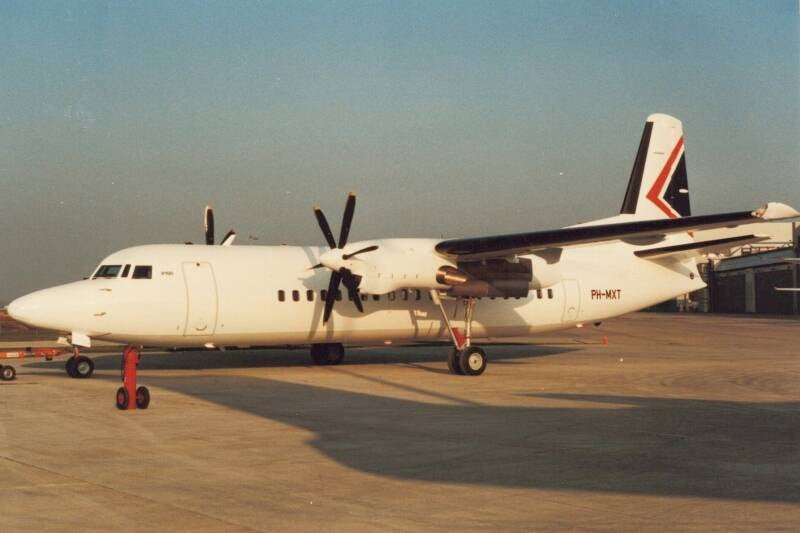
PH-MXT (20298) still carrying the erroneous registration; the number behind the cockpit clearly says P198, the internal Fokker construction number. It was repainted as PH-MXR before the first flight. (unknown photographer, photo scan from Hans Groen collection, Amsterdam, November 1993)
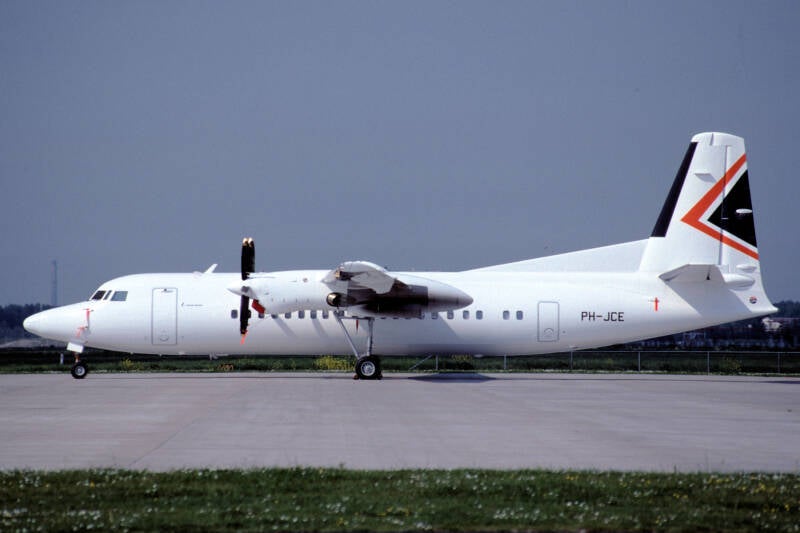
PH-JCE (20302) with small ‘Vietnam Airlines’ logo and titles next to the passenger door. (unknown photographer, slide scan from author’s collection; Amsterdam, May 1994)
Credits
- Special thanks to Frank Ellemers for providing critical comments and supplying valuable data on the subject.
Maak jouw eigen website met JouwWeb