Long-nosed Friendships
When the Fokker F27 Friendship was designed in the early 1950s, it was not standard practice yet to equip regional aircraft with weather radar systems. As a consequence, the first production airframes were delivered without weather radar and had a blunt, or what we now call, short nose. In contrast, the Fairchild F-27, the US license version of the Fokker F27, was equipped with a radar in the nose from the design phase on and had a more pointed nose, which was approximately 0.4 m longer than the Fokker version. In late 1958 Fokker modified their second F27 prototype (PH-NVF, 10102) with a Bendix radar in a Fairchild F-27 nose instead of the then F27 standard nose. In 1961 Fokker made this longer nose with Bendix weather radar the standard version and from c/n 10176 on all Friendships were equipped with the longer nose (see Fig 1). Later a number of older Friendships were refitted with the longer radar nose.
Of all 792 Friendships built, three have temporarily been equipped with an extra-long nose for special purposes and these three are the subject of this article.
C-8 (10158) Royal Netherlands Air Force (RNLAF)
In July 1959 the Dutch Government ordered 12 F27s on behalf of the Royal Netherlands Air Force, three F27 Mark 100 Friendships, one of which was a VIP version, two were in standard passenger layout and nine were F27 Mark 300M Troopships, the military variant. The first one was taken on strength in July 1960 and the twelfth one in April 1961. All twelve were assigned to 334 sqn for a wide variety of transport duties, which until then had been the task of the Douglas DC-3/C-47. When delivered all 12 F27s were in the short-nose configuration and they were retrofitted with the standard long nose from 1971 onwards.
When the RNLAF started operating the Lockheed F-104G Starfighter in the mid-1960s, they needed a training facility for familiarizing F-104 pilots with the fighter’s innovative NASARR (North American Search and Ranging Radar) system. While other NATO air forces modified one or more of their DC-3/C-47 aircraft for this purpose, the Dutch air force choose to convert a F27 into a NASARR flying classroom. The Fokker facility at Ypenburg Air Base fitted a 2.5 m long Starfighter nose cone, housing the NASARR radar antenna, to Troopship C-8 (10158). The modified aircraft was handed over to the RNLAF on 2 November 1966 and immediately started its flying training, nicknamed ‘Flipper’ after a then popular television program where a dolphin was starring (Fig 2).
In the cabin one position was installed as a replica of the F-104 cockpit, complete with all the essential radar and navigation equipment controls for the instructor and one student. Behind this another position was built for three students, who were able to follow the first student and the instructor. In that manner it was possible to teach four student pilots simultaneously (Fig 3). Instructor and trainee-seating facilities were attached to the cabin floor by quick fasteners, enabling easy removal of the entire training unit for making the F27 quickly available for its normal transport job.
During a flight from Ypenburg to Twenthe Air Base on 7 May 1968, the F27 was hit by lighting and the long nose-cone was lost in mid-air. As the added value of the flying classroom was regarded limited, C-8 was restored to normal Troopship configuration shortly afterwards. During its 1.5 years as NASARR trainer, C-8 maintained the standard color scheme: white on top, grey belly, a thin blue cheatline and areas of orange dayglow on nose and tail. Later the name ‘Flipper’ and a dolphin cartoon were applied under the cockpit (Fig 4).
There had been plans to equip a second Troopship (C-9, 10159) with the NASARR nose and equipment, but this never materialized.
VH-CAT (10132) Commonwealth Scientific Industrial Research Organization (CSIRO)
VH-CAT (10132) CSIRO Office of Space Science and Applications (COSSA)
VH-CAT (10132) Airborne Research Vehicles Australia (ARVA)
With a history originally going back to 1916, CSIRO was established by the Australian government in 1949 as the national science agency, tasked with scientific research and its commercial and industrial applications. The CSIRO headquarters are located in the federal capital Canberra and the organization operates at 47 sites spread all over Australia. The CSIRO activities are organized in business units covering many subjects, for example health & medical, energy, production, disasters, agriculture & food, mineral resources, technology & space and environment.
In 1965 the CSIRO Physics division had obtained a surplus Douglas C-47 from the Royal Australian Air Force and converted it to civil standard. They equipped the aircraft for cloud seeding and rain making. In July 1978 this Dakota was replaced by Friendship VH-CAT (10132) when it was retired by the Department of Civil Aviation, which had used it for navigation aid calibration and airport survey work.
CSIRO modified the newly acquired F27 as a research aircraft by installing three sets of instruments: ten hard-points for external sensors for atmospheric measurements like pressure and temperature, devices in the cabin for converting sensor signals and storage systems for data and air samples collected in-flight for later investigation in ground laboratories (Figs 5 and 6). For exact location information the aircraft was also equipped with a navigation rack on the port side of the cabin, equipped with a suite of navigation aids that were completely independent of those used by the flight crew. Most of the instruments were developed and built in-house by CSIRO. Also, the engines were upgraded from RDa 6-511 to RDa 6-514 standard that gave better take-off performance at high ambient temperature by using water-methanol injection. The modifications were performed by East West Airlines, who also operated and maintained the aircraft from their Tamworth base. With support by Fokker and the Australian CAA, a special maintenance scheme was developed for the F27 and on all research missions a fully trained engineer was added to the crew and a huge stock of spares and the complete maintenance manuals were carried onboard in the rear baggage compartment.
CSIRO started using their F27 in June 1979. The first series of experiments were to investigate atmospheric conditions during cloud-seeding performed by Piper PA-31 aircraft that disseminated silver iodide crystals as water condensation nuclei. Despite that these experiments were planned to last three years, the program was ended after the first season, due to lack of economically useful data.
In 1980 a 5.5 m long nose-cone of Australian design was fitted as housing for 28 instruments. The long nose-cone facilitated turbulence measurements in undisturbed air ahead of the aircraft (Fig 7). Initially the aircraft was nicknamed ‘Porcupine’, and sometime in 1981 the name ‘Cyrano’ was applied to the nose of the aircraft, after the legendary huge, sharp nose of the 17th century novelist Cyrano de Bergerac.
In October 1986, VH-CAT was transferred to COSSA, the CSIRO Office of Space Science and Applications, the unit for Atmospheric Research. Early in November 1986, the CSIRO tail logo was removed and COSSA titles were added. Few months later small titles ’Research Aircraft Facility‘ were added behind the aft door (Fig 8). In July 1991 the operations and maintenance of VH-CAT were transferred from East West Airlines to the Civil Aviation Authority for one year.
Australian Flight Test Services bought the aircraft in July 1992 and leased it back to CSIRO for 150 hours per year; it regained its original CSIRO livery. In March 1996 it was noted with ‘Airborne Research Vehicle Australia’ (ARVA) titles and logo in the tail (Fig 9).
As several CSIRO divisions used the aircraft, the instrumentation was adapted according to the needs of the various users, such as the Division of Exploratory Geo Science-mineral Exploration and Study (for geophysical surveys), the Division of Coal and Energy (for example for analyzing smoke plumes around power stations) and the Division of Oceanography and Fisheries (for studying fish shoals, sea grass and reef deterioration).
The aircraft had some special features, in particular a dropping tube for releasing sonobuoys and probes from the pressurized cabin and uniquely an onboard diesel-driven Ground Power Unit (GPU) allowing researchers to carry out pre-flight checks and equipment maintenance in the field.
Photographic evidence exists that the extra-long-nose configuration has been used by all three operators mentioned in the section heading; also, they all have used it without the extra nose-cone and with and without external sensors.
VH-CAT was withdrawn from use in March 2001 and put in storage, initially at Melbourne, later at Adelaide. In 2003 Omega Inc bought the aircraft, but as far as we know did not fly it. Early 2008 it was bought by the South Australia Aviation Museum and in December of that year trucked to their museum location at Port Adelaide, where it is on public display since. Also, the extra-long nose is there as a museum exhibit, unfortunately not attached to the aircraft nose but wall-mounted.
F-BYAO (10127) Institut Géographique National
F-WYAO (10127) Institut Géographique National
Institut Géographique National (the French national geographic institute, IGN) was established in 1940 as the successor of the Geographic Service of the French Army. Its task is the production, maintenance and distribution of geographic information and since 2012 it is also responsible for information on the national forests in France. For making high-resolution maps IGN has heavily depended on aerial photography, for which the institute used a few modified Boeing B-17s and the quite rare Hurel-Dubois HD.34 survey aircraft.
In July 1985 IGN acquired a Fokker F27 Mark 100 that had previously been in use with Australian East-West Airlines and Uni-Air of France. The Friendship was modified to Mark 700 standard with a large cargo door by Fokker at Ypenburg. Subsequently SECA, a subsidiary of Aérospatiale, designed and applied extensive modifications, including:
- the most conspicuous was a 5.6 m long nose-cone to accommodate sensors that had to be located upstream of the turbulence created by the aircraft. This extra-long cone was supplied by the same Australian company that designed the nose for the CSIRO Friendship discussed above;
- two camera windows in the belly of the aircraft with an automatic defrosting and defogging system and automatic shutters. At the forward end of the dorsal fin a third window was created for the then highly sophisticated LEANDRE lidar (laser imaging, detection and ranging) system with a diameter of 350 mm;
- a 24-kW auxiliary power unit in the rear fuselage to supply electricity for the scientific equipment;
- a variety of sensor attachments: six in a ring-shaped layout just behind the cockpit, two pods above and one under the fuselage, two external and two internal underwing hard points for fitting measuring equipment;
- new wing tanks for an additional 1000 kg of fuel for increasing flight autonomy;
Most of the equipment was removable to make ARAT as versatile and flexible as possible for user needs, but some sensors for atmospheric measurements were permanently installed. The entire modification effort took 15 months and some 35,000 working hours. The final configuration was very similar but not identical to the CSIRO aircraft.
The IGN F27 was called ARAT (Avion de Recherché Atmosphérique et de Télédétection), which means atmospheric research & remote sensing aircraft. For the ARAT operations IGN cooperated with the Institut National des Sciences de l'Univers of the Centre National de Recherches Scientifiques (CNRS-INSU; the national center of scientific research of the national institute of universal sciences), the Centre National d'Études Spatiales (CNES; national center of space studies) and the Direction de la Météorologie Nationale (DMN; now called Météo France). INSU took care of all atmospheric research equipment and CNES of the remote sensing installations. In 1988 ARAT was tested by the Centre d’Essais en Vol (CEV; the former name of the flight-testing branch of the French Armed Forces) and then IGN put it into service.
When acquired, the aircraft was registered F-BYAO and after the modifications maintained that registration. On 12 June 1988 it was re-registered to F-WYAO and it participated as such in the Paris Air Show in June 1989 (Figs 10 and 11). In December 1991 the original registration F-BYAO was restored (Fig 13). ARAT was withdrawn from service on 14 July 2002 after having flown 2,541 hours and made 1,138 landings. It was stored at Creil Air Base and five years later sold for parting out. The registration F-BYAO was cancelled in February 2010 when scrapping at Dinard was completed.
In 1985 IGN expressed their interest in buying another F27, preferably a Mark 400, and repeated the interest in 1995, now for a F27 or Fokker 50, but the interest never led to a purchase. So, there were no more than three extra-long-nosed Friendships. In passing we can note that the French DGA-EV currently operates two F100s with a long radar nose, as described in a previous article (https://www.fokkernews.nl/articles/special-mission-fokkers/dga-ev).
Long-nosed Friendship pictures

Fig 1: The original, blunt nose of F27 PH-FAD (10108) for Braathens SAFE on the left and on the right the, longer, pointed of Braathens SAFE LN-SUE (10245) that became the standard. (photos by Fokker, 1958 and Ken Fielding; April 1964, respectively)

Fig 2: RNLAF C-8 (10158) showing its prominent NASARR nose; note that the name ‘Flipper’ has not been applied yet. (Fokker Heritage Trust; unknown location 1966)

Fig 3: The interior of C-8 (10158) with the NASARR equipment for instructor and trainee and three observer seats. (Fokker Heritage Trust; unknown location 1966)
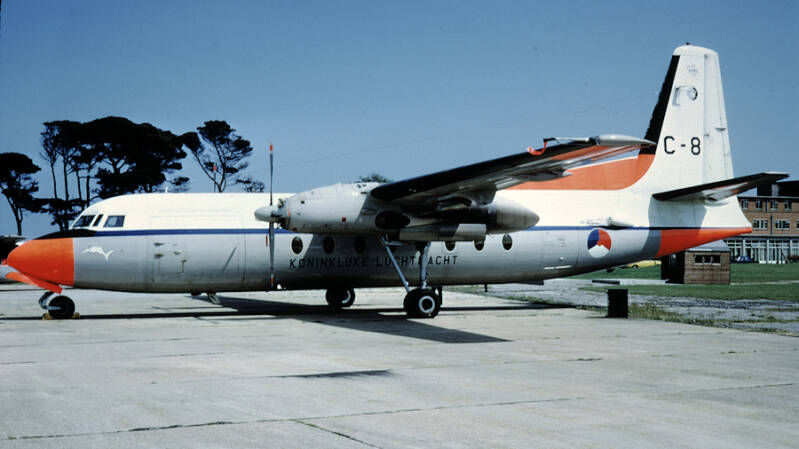
Fig 4: RNLAF C-8 (10158) with the ‘Flipper’ cartoon under the cockpit; the radar nose is no longer present. (unknown photographer, slide scan from Hans Groen collection; unknown location, May 1972)
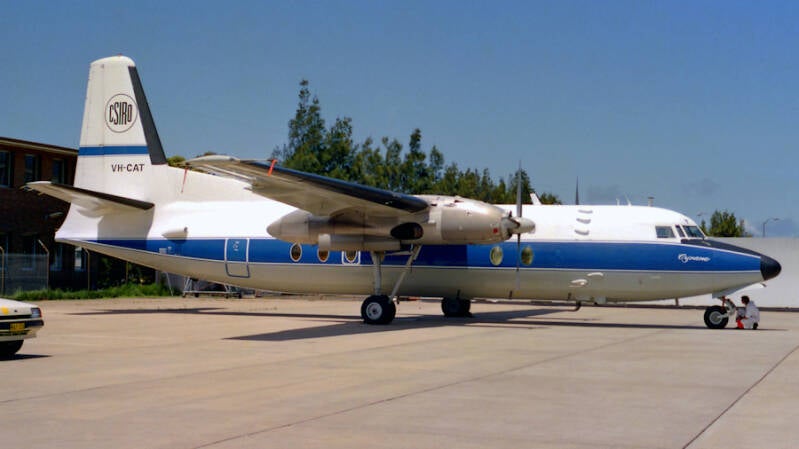
Fig 5: CSIRO VH-CAT (10158) with the sockets for measuring equipment unoccupied and without the extra-long nose cone. Note the name 'Cyrano' on the nose. (Peter Gates; Sydney, November 1978)
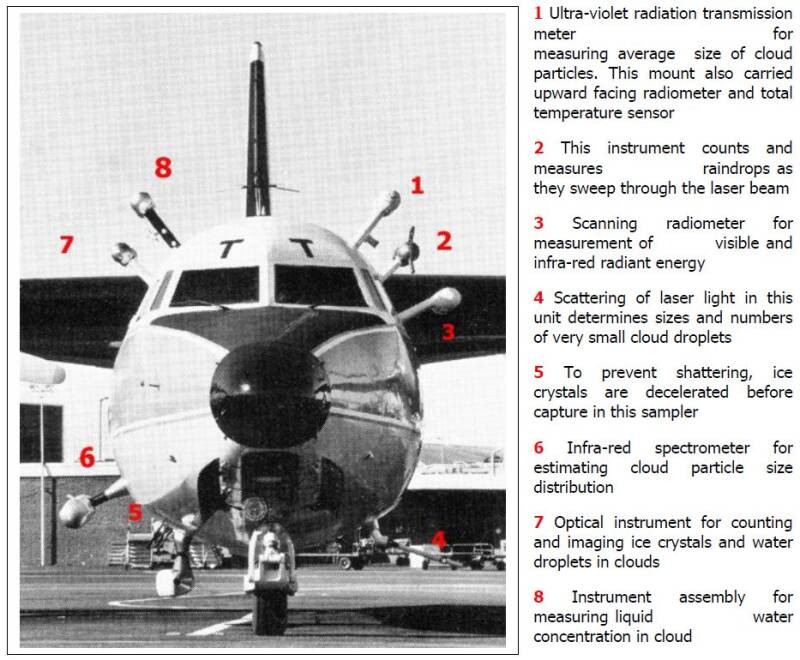
Fig 6: Frontal view of VH-CAT (10132) clearly shows the array of measuring instruments just behind the cockpit. (CSIRO; location and date unknown)
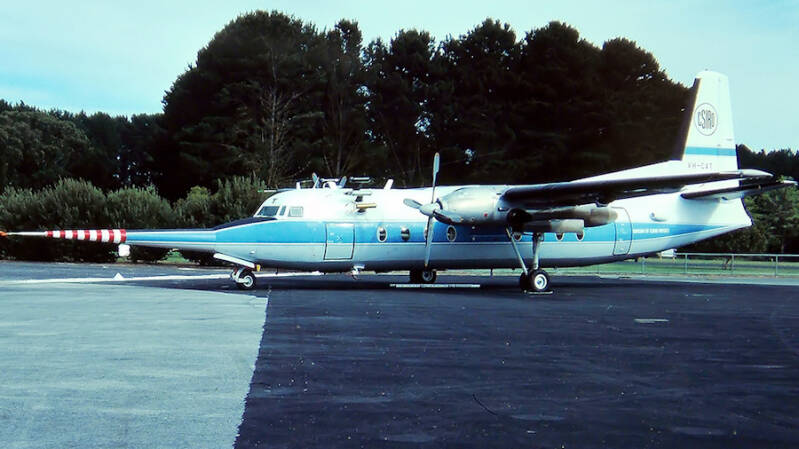
Fig 7: VH-CAT (10132) with the extra-long nose-cone in CSIRO livery. (David Tanner; Mount Gambier, 22 November 1981)
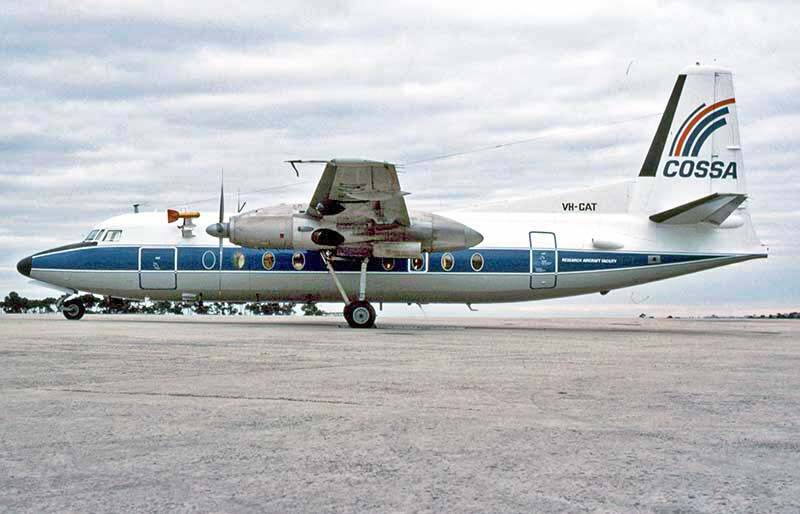
Fig 8: VH-CAT (10132) in COSSA livery, equipped with instruments on the front fuselage, but without the extra-long nose-cone. Note the ’Research Aircraft Facility’ titles. (unknown photographer and location, July 1988)
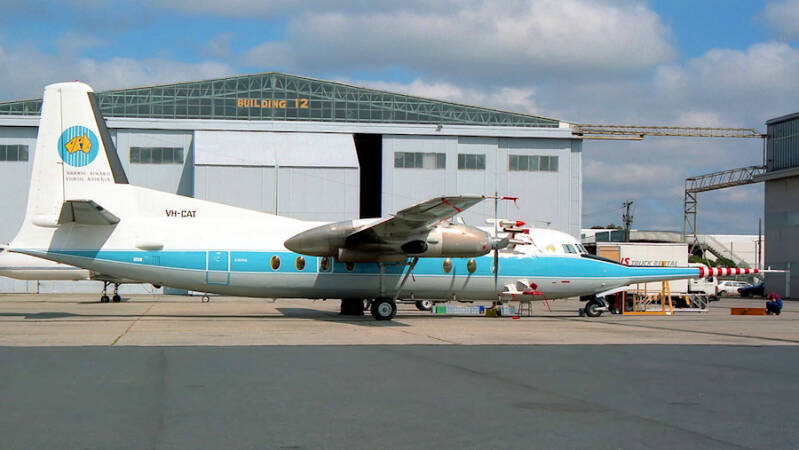
Fig 9: VH-CAT (10132) now in ARVA livery, heavily loaded with instruments and the extra nose-cone. (Brian Wilker; Melbourne, 1998)
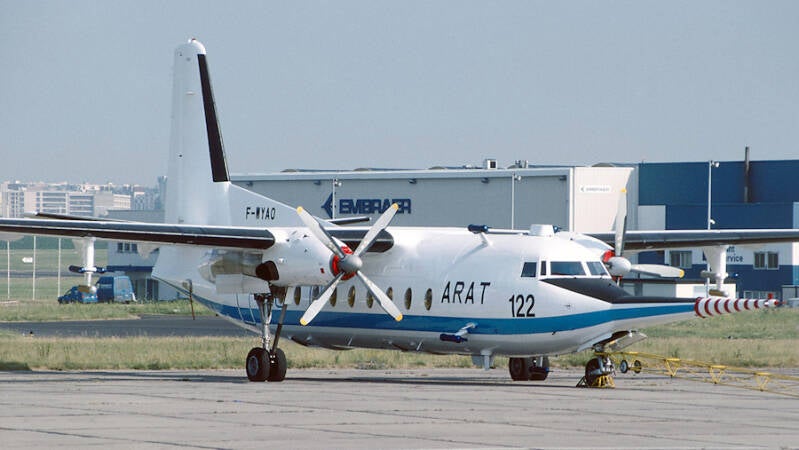
Fig 10: IGN F27 F-WYAO (10127) with external equipment and the long nose-cone participating in the Paris Air Show. (Gerard Helmer; Paris-Le Bourget, June 1989)
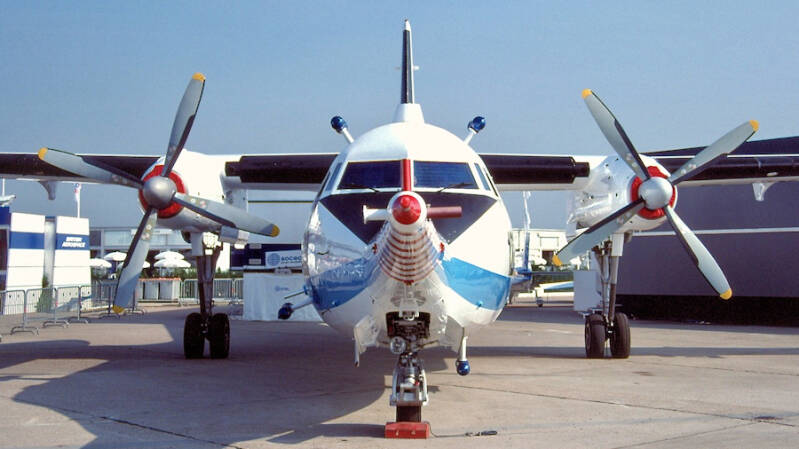
Fig 11:Frontal view of IGN ARAT F-WYAO (10127) showing the extra-long nose-cone and external sensors. (GadFly; Paris-Le Bourget, 1 June 1989)
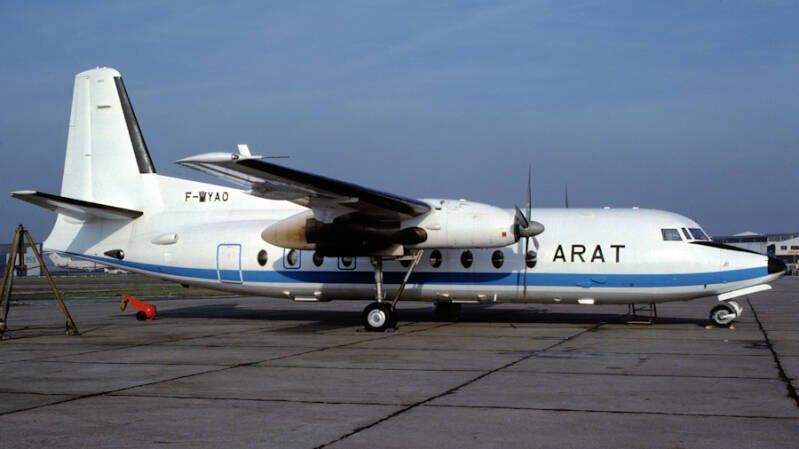
Fig 12: IGN ARAT F-WYAO (10127) in the basic configuration, without external appliances. (unknown photographer, slide scan from Hans Groen collection; unknown location and date)
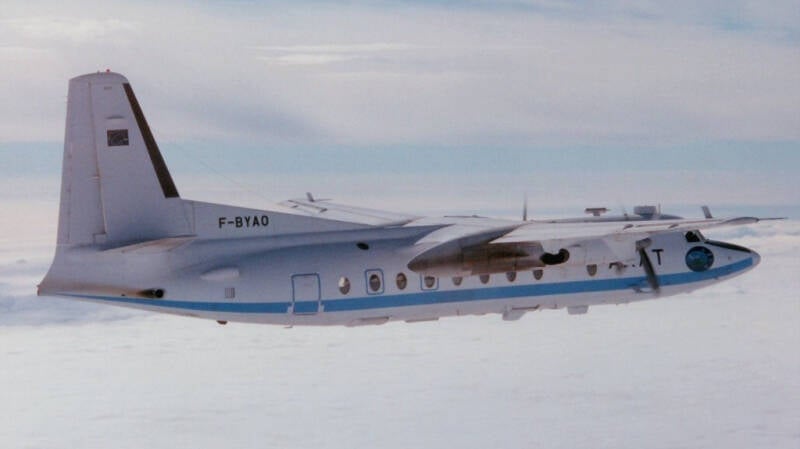
Fig 13: IGN F-BYAO (10127) after re-registration, in the basic configuration. (Phil Hignett; in flight over south-England, 15 October 1998)
Credits
- F. Homma and H.K. Groen. The Fokker F27 Friendship story. CD-ROM, April 2011.
- P. Dekkers. Daar heb je Flipper – De merkwaardige geschiedenis van de Fokker Friendship C-8: https://carre.nederlandseofficierenvereniging.nl/carr-nr-8-2021/kerstverhaal/
- CSIRO – Australia’s national science agency: csiro.au
- D.J. Llewellyn: VH-CAT Fokker F27 CSIRO Story. https://5dme.net/stories-vh-cat-fokker-f27-csiro-story/
- Wikipedia: https://fr.wikipedia.org/wiki/Institut_national_de_l%27information_g%C3%A9ographique_et_foresti%C3%A8re
Maak jouw eigen website met JouwWeb